What is a talkbox plugin, and what does PRISM Talkbox do differently?
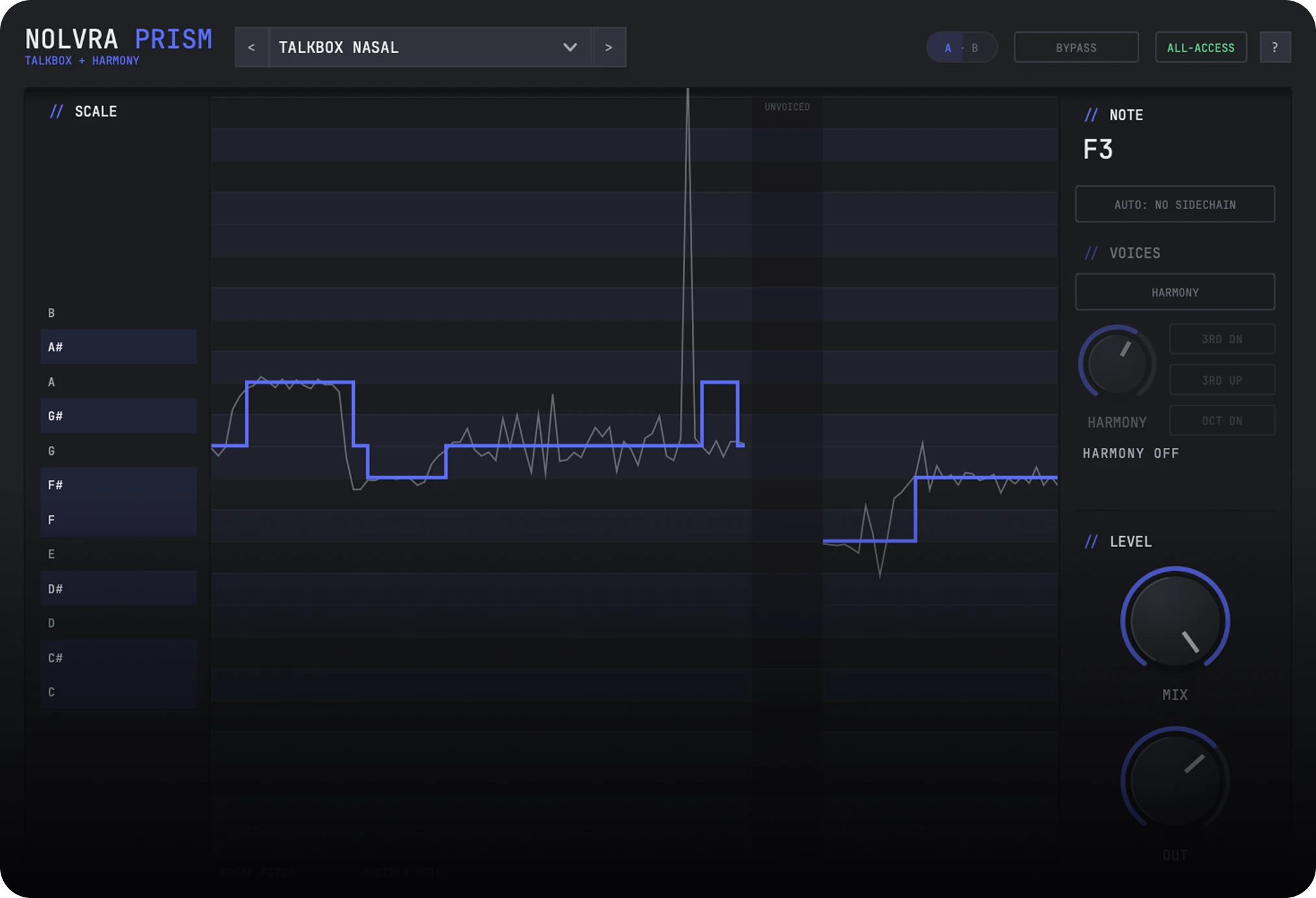
PRISM Talkbox is a talkbox plugin with the carrier built in and harmony on top. Every talkbox asks you for a carrier first: load a synth, print a pad, route it in, then sing over it. PRISM ships with the carrier inside, so you drop it on the vocal track, sing, and it plays. The engine follows the pitch of the voice it hears and keeps the line in your key: MIDI first, then the chord it hears on the sidechain, then your key and scale. Up to three harmony voices pass the same gate as the lead. PRISM Talkbox is a talkbox, not a vocoder, and the difference is audible. A vocoder splits a voice into bands and stamps that shape onto a synth. A talkbox shapes a single driven voice with the resonances of a mouth, which is why the classic records people file under vocoder are mostly talkbox records. It loads as AU or VST3 on macOS 11 or later, Apple Silicon. If you want the mechanics, we wrote them down: Talkbox Versus Vocoder.
How it works
A talkbox with nothing to plug into it
Every talkbox asks you for a carrier first: load a synth, print a pad, route it in, then sing over it. PRISM Talkbox ships with the carrier inside. Drop it on the vocal track, sing, and it plays. That is the whole setup.
Drop it on the vocal
PRISM is an audio effect, not an instrument. It goes on the track that already carries your voice, and it plays live while the transport runs.
Sing the melody
No MIDI part, no keyboard, no chord track. The engine follows the pitch of the voice it hears and shows you the note it settled on while you sing.
Pick a mouth
Eleven factory presets, all of them saved by playing the product rather than typed into a table. Save your own beside them.
In key
It does not fall out of the song
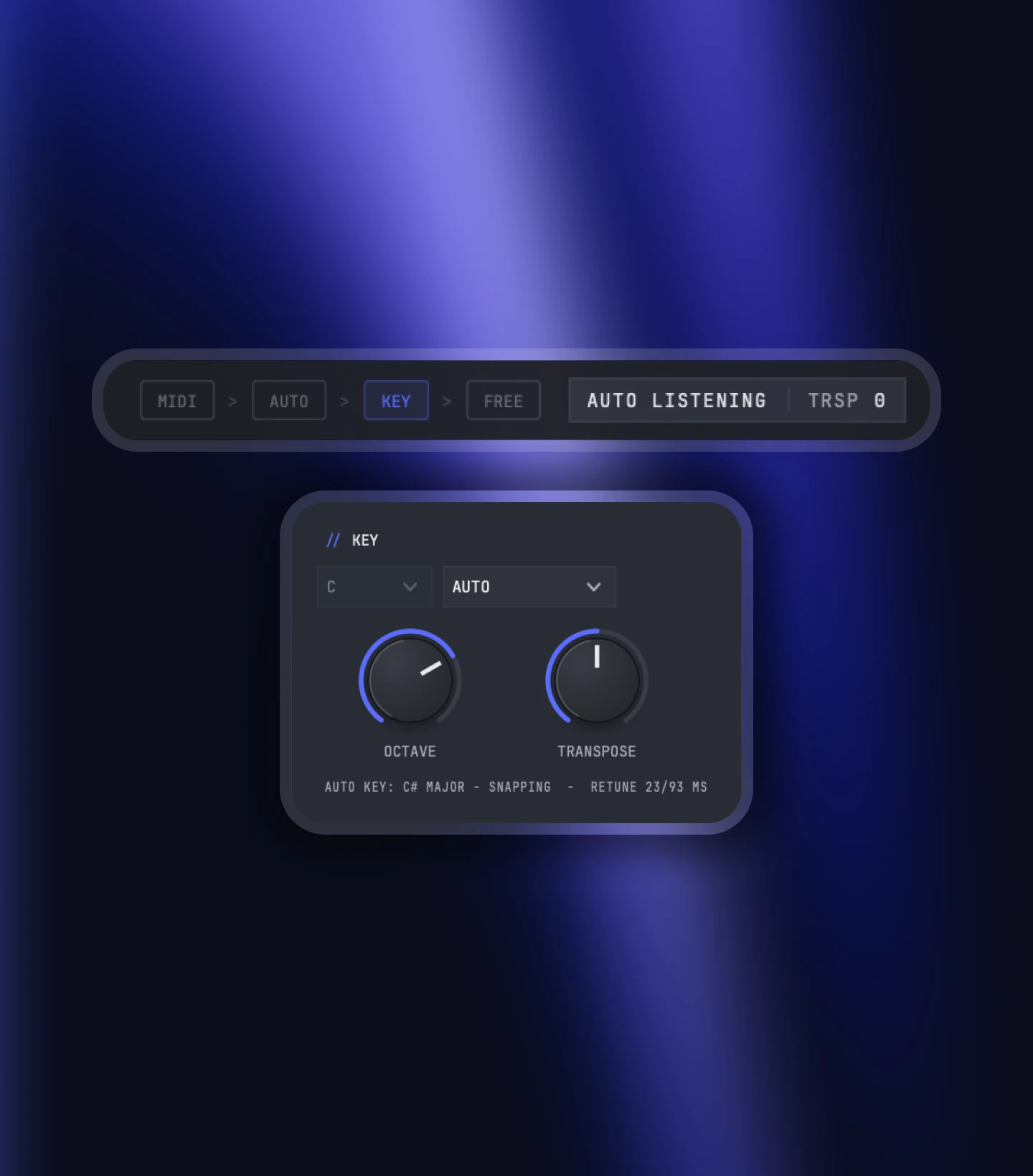
A talkbox line that drifts a semitone is worse than no talkbox line. PRISM has four ways to decide which note to play, and the order between them is fixed: MIDI first, then the chord it hears, then your key, then the voice alone. The numbers behind that: with a chord locked, the line lands on a chord tone 95.5% of the time, against 36.3% for a fixed note. With key and scale set, out-of-scale decisions go to zero. The pitch follower sits within 0.3 of a semitone of the voice it is following. And when AUTO has not gathered enough evidence to name a key, it says so on screen and quantises nothing: a wrong lock is worse than no lock.
- MIDISend notes and the keyboard plays the pitch. Nothing is quantised, because you already chose it.
- AUTOFeed the track to the sidechain and PRISM hears the chord, then snaps the line to the notes in it. The chip names the chord it heard.
- KEY and SCALENo chords to give it? Set the root and the scale and every decision the engine makes lands inside them. AUTO works this out from what you sing.
Harmony
Harmony that cannot fall out of the song
The other half of the product. Three voices, the same gate as the lead, and a chain behind them, so the sound that leaves PRISM is the sound you keep. The live scene draws the decision, not a waveform: your raw pitch, the note the engine committed to, and the harmony voices, six seconds at a time. When there is no signal it says LISTENING rather than inventing a picture.
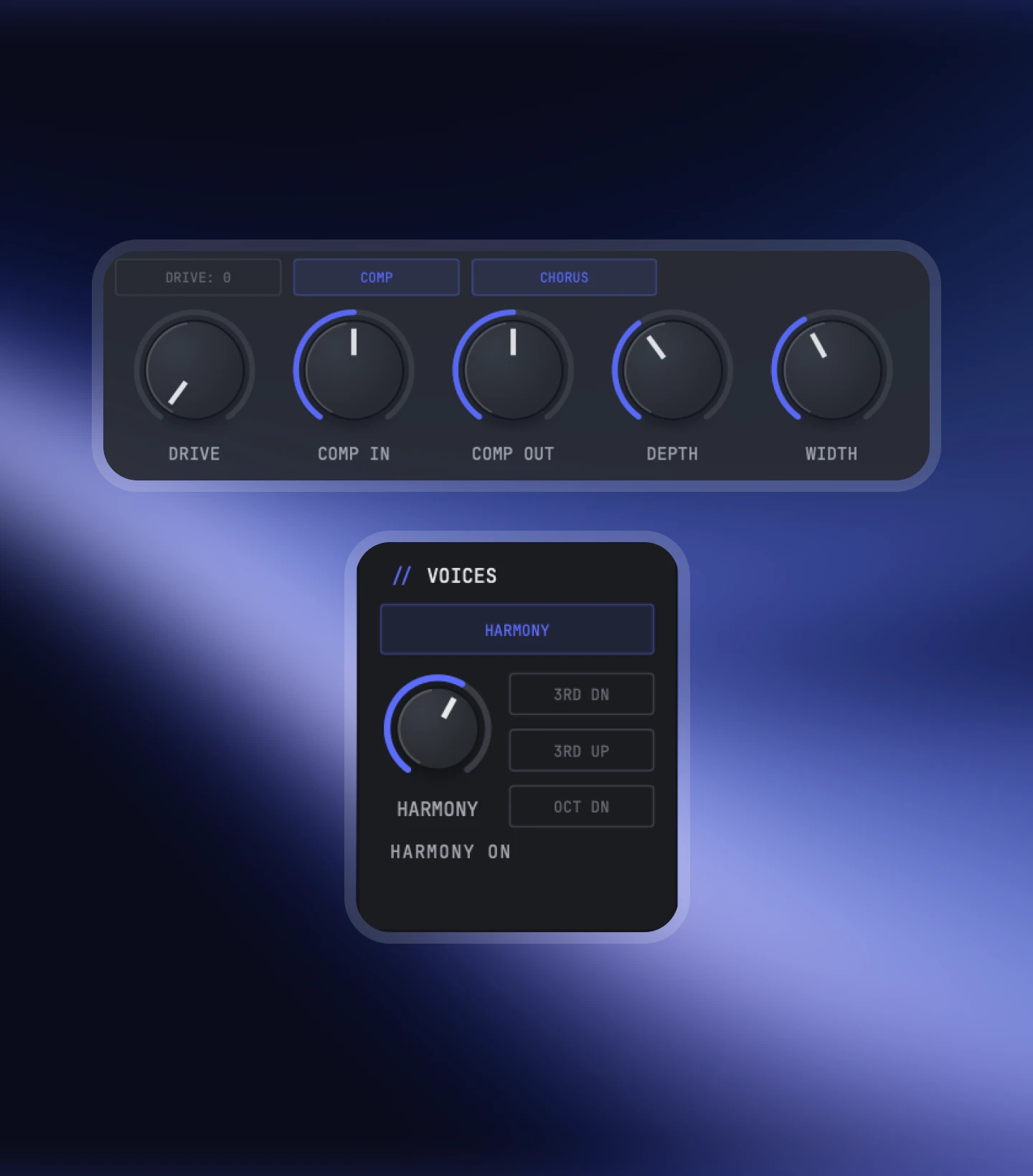
- Up to three harmony voicesA third below, a third above, an octave below, each on its own switch. Every voice passes the same gate as the lead, so harmony cannot fall out of the scale either. The lead stays 8 to 17 dB in front of them.
- Compressor and chorusAn LA-2A style compressor and a stereo chorus sit at the end of the wet path, both on by default, both a single bypass. The mono sum costs 0.67 dB.
- How much of you is leftMIX sets the talkbox against your dry voice. DRY sets the two paths your own signal still travels, the consonants and the air, so intelligibility is your call.
Compared
PRISM Talkbox compared to the other ways to get a talkbox
Four ways producers get a talkbox line into a session, and what each one asks of you before the voice comes out shaped. Prices and specs checked against each maker's own page in August 2026.
| Product | Price | What it is | Pitch and key | What you plug in |
|---|---|---|---|---|
| Nolvra PRISM Talkbox | $99 once, or included in All-Access at $19.99/month | Talkbox with the carrier built in, up to three harmony voices, compressor and chorus on the wet path | Follows the voice. MIDI first, then the chord on the sidechain, then your key and scale | A vocal track. No synth, no MIDI part, no chord track |
| iZotope VocalSynth 2 | $199 list | Five-module vocal synth: Vocoder, Compuvox, Polyvox, Talkbox, Biovox | Auto, MIDI or sidechain carrier, your choice per session | Runs as an audio effect in AAX, AU, VST2 or VST3; a carrier for sidechain mode |
| Waves OVox | $149 list | Voice-controlled synth and vocal FX processor: tuning, harmonizing, vocoder, talkbox | Automatic note mapper, or MIDI | Plugin or standalone app |
| MXR Talk Box M222 | $209.99 | Hardware talkbox pedal with its own amp and speaker driver | Whatever you plug in plays the pitch; you shape it with your mouth on the tube | A guitar or keyboard, an 8-foot surgical tube, a microphone and an 18-volt supply |
The choice is between a vocal suite that has a talkbox in it, a pedal with a tube, and a talkbox that is only a talkbox. The suites give you five engines and ask you to pick a carrier and a mode; the pedal gives you the real thing and asks for a guitar, a tube and a microphone. PRISM keeps the one job and drops the setup: the carrier is inside, the pitch comes from the voice, and the harmony passes the same gate as the lead.
Product details
Technical specs
The practical details, organized for a quick scan.
Engine
Signal
- TypeLive talkbox, built-in carrier
- PitchFollows the voice; MIDI, sidechain chord, or key and scale
- HarmonyUp to three voices, each switchable
- ChainCompressor and chorus on the wet path
- Latency5 ms
Workflow
Session ready
- PlacementAudio effect, on the vocal track
- Presets11 factory, plus your own
- A/BTwo full settings, one switch
- Controls28 parameters, none more than two clicks away
- BypassHost bypass, one control
Output
Plugin formats
- FormatsAU and VST3
- ProductTalkbox
Platforms
System support
- macOS11 or later, Apple Silicon
- WindowsComing soon
- ManagerNolvra Hub, 14 or later
- UpdatesThrough Hub
Available for macOS and Windows. On Mac, runs on Apple Silicon today, Intel support coming. VST3 and AU on Mac, VST3 on Windows. Full system requirements
License
One license, every session
A PRISM Talkbox license activates on two machines that you personally own and use, and they can be any mix of Mac and Windows. A one-time key is entered inside the plugin itself; All-Access, the trial and every update go through the Nolvra Hub, which is free.
Purchase
Buy once, or get it with Nolvra All-Access.
Download
Open Nolvra Hub, sign in, and install PRISM from there.
Install & create
Drop it on the vocal, sing, and the line lands in your key.
FAQ
Before you buy
Do I need a synth or a MIDI part to use it?
No. The carrier is built into the plugin and the engine follows the pitch of your voice, so a vocal track with PRISM Talkbox on it is the whole setup. MIDI is there if you want it, but nothing is waiting for it.
Is this a vocoder?
No. PRISM Talkbox is a talkbox, and the two work differently. A vocoder measures a voice in frequency bands and stamps that shape onto a carrier synth. A talkbox drives one voice through the resonances of a mouth. Most of the records people file under vocoder are talkbox records, which is why this sounds like them.
Can I make it stay in the key of my song?
Yes, three ways, and they have a fixed order. Send MIDI and you play the pitch. Feed the track to the sidechain and PRISM snaps the line to the chord it hears. Or set a key and a scale and every note the engine decides on lands inside them. Key and scale are outside preset scope, so loading a preset never takes your song's key away from you.
Does the harmony stay in the key too?
Yes, and that is half the point of it. Up to three voices, a third below, a third above and an octave below, each on its own switch. Every voice is quantised through the same gate as the lead, so across all three of them out-of-scale notes measure zero. The lead stays 8 to 17 dB in front, so the harmony sits behind the line rather than competing with it.
What formats and systems does it run on?
AU and VST3 on macOS 11 or later, Apple Silicon. Windows is coming, with no date on it yet. Both formats pass pluginval at strictness 10 and the AU passes Apple's own auval.
How does activation work?
Through an All-Access membership or the trial, sign in to the Nolvra Hub and PRISM unlocks there. A one-time key is entered inside the plugin itself and does not expire. A license activates on two machines that you personally own, and they can be any mix of Mac and Windows. If a membership loses its connection the plugin keeps working offline for 14 days.
Is it in All-Access, and can I try it first?
Yes to both. PRISM Talkbox is one of the plugins All-Access covers, and the 7-day trial opens it with no card. The trial is for plugins: sample packs open with a purchase or a membership.
Further reading
Guides that use it
How PRISM fits a session, written out step by step.
- Talkbox Versus VocoderBoth make an instrument talk. One uses your mouth as the filter, the other uses your voice as a control signal.
- Find The Key Of Any SamplePitch, not guesswork. Find a loop's root by ear in under a minute, and stop your 808 from fighting the vocal.
- Pitch A Vocal Loop Into Your Key, No ChipmunkPitch shifting moves formants along with the notes, and the ear reads formants as body size. Why that sounds wrong, and what to do instead.
- Vocal Chain OrderEQ, compression, de-esser, reverb. The order is not taste: each stage changes what the next one hears.
- Chop A Vocal Loop So It Stays In TimeA vocal starts before its transient. Cut at the wrong point and the slice reads late, clicks, or loses the groove the loop already had.
- Which Nolvra Plugin FirstThe order is set by what your tracks are missing, not by the product list. Four problems, four answers, and where one plan actually makes sense.
Start with PRISM
Get PRISM
Put it on the vocal and sing. The carrier is already inside.
$99