
 Creative processWorkflow
Finish Ideas Faster
Most unfinished tracks died in the browser, not in the arrangement. Cut the number of decisions, not the quality.
Creative processWorkflow

The order is set by what your tracks are missing, not by the product list. Four problems, four answers, and where one plan actually makes sense.
The right first plugin is not the best one, it is the one that fixes what your last three tracks were missing. That reframing does the real work here, because a feature list cannot tell you which tool you need and a stalled session can. Four problems come up constantly: joins between sections that feel empty, low end that disappears on small speakers, a vocal that brought somebody else's room with it, and a mix that is technically clean and completely characterless. Each one has a different answer, and one of the four answers costs nothing to try.
If the arrangement is right and the joins still feel empty, what is missing is transition material: risers, sweeps, sub drops, the elements that carry the ear across a bar line. SURGE is a bank of those files rather than a synth. You audition what is already rendered, it follows the session tempo, and the file you heard is the file you drag into the timeline.
If the bass is fine in your room and gone on a phone, or the kick and the 808 keep swallowing each other, you are treating one instrument as two. PLUNGE builds subs, 808s and reese in a single engine and locks the result to your kick, so the space the kick needs is written into the note instead of carved out of it later with a sidechain.
An acapella, a bounced take, a phrase lifted from a video: they all arrive carrying the room they were recorded in, and reverb baked into a source fights every reverb you add after it. RAW removes it offline, with the model running on your machine and nothing sent anywhere. You capture the audio, select the range in the waveform, and drag the dry version into the project.
If the mix is correct and lifeless, what is missing is damage applied on purpose: tape, vinyl, VHS or radio. RELIC does exactly those four and costs nothing with a Hub account, with no time limit and no locked features. Its AGE control is a macro, so one knob moves six parameters per character along their own curves. This is the door you can open today.
The instinct is to compare specifications and take the one that does the most. It fails here because these tools barely overlap. A bank of sweeps does nothing for a low end problem. A de-reverb tool does nothing for an empty transition. The most capable plugin in any catalog is useless in the session where the thing you actually needed was one of the others.
So pick from the track instead. Open the last three projects you abandoned and write down where each one stalled. The answers repeat more often than producers expect, and the repeated answer is the tool that changes the most work. If nothing repeats and everything is just slightly thin, start with the free one and spend money later, once you know more about your own failure mode.
All-Access covers what is in the plan, SURGE, PLUNGE, RAW, PRISM PRO, RIDGE and IMAGER, plus the sample packs included in it, along with monthly drops and new releases as they land. It is a reasonable answer when your list has more than one item on it: transitions and low end, or low end and vocal cleanup. It is not a reasonable answer when you have one clear problem and already know which tool solves it. Buying the tool is the better move then.
The trial runs seven days and takes no card, so nothing charges you at the end. It opens the plugins only, which means the sample packs stay closed while it runs. That is enough time to answer the question that predicts everything else: when you sat down to work, did you reach for one of them without thinking, or did you forget it was installed.
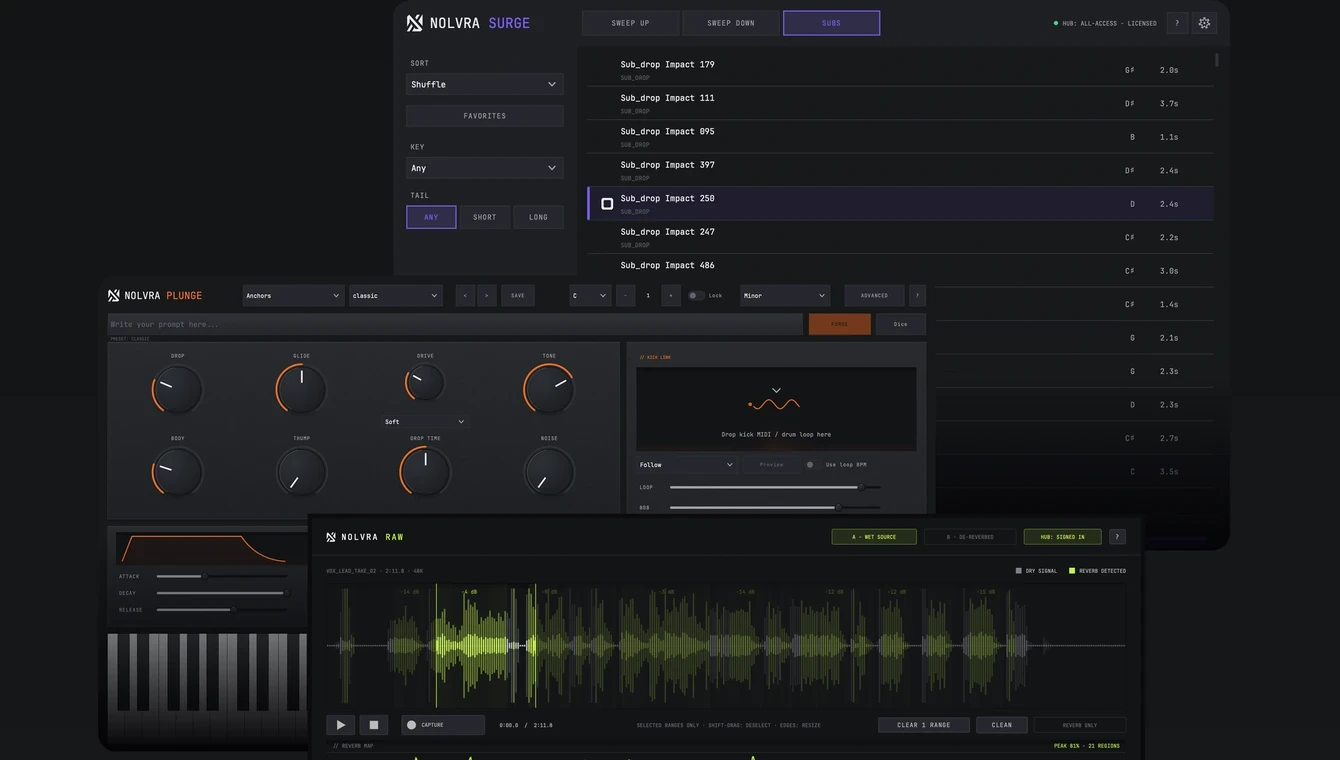
All-Access covers what is in the plan, SURGE, PLUNGE, RAW, PRISM PRO, RIDGE and IMAGER, plus the sample packs included in it, with a seven day trial that needs no card.

Put it on the vocal and sing. The carrier is already inside.
Guides
You may also like
Creative processWorkflowMost unfinished tracks died in the browser, not in the arrangement. Cut the number of decisions, not the quality.
 WorkflowBuying
One time payments answer an ownership question. Subscriptions answer an access question. Three things to check before you decide which you are asking.