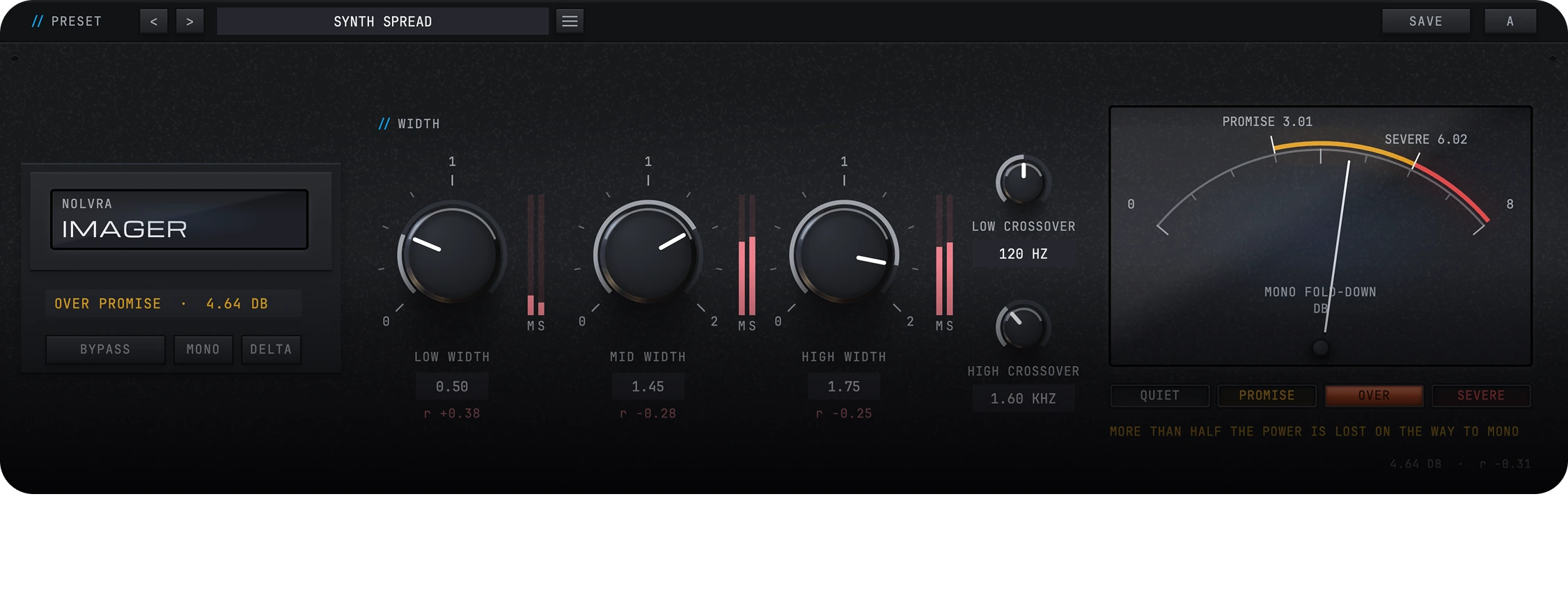
How do I know if my mix will survive being played in mono?
Most of the rooms your record gets played in will sum it to mono, and what survives that sum is the mid signal. The usual way to check is to switch a monitor controller to mono, listen, switch back, and decide with your ears, which takes minutes and gives you an impression rather than a figure. IMAGER measures it instead. It watches the broadband fold-down loss at its own output, continuously, and prints it in dB against two lines that are drawn where the arithmetic changes: 3.01 dB, the rung where correlation reaches zero and half the power is gone, and 6.02 dB, where three quarters of it is. The reading moves the moment the mix moves, because it is measured and not predicted, and it is taken after the plug-in, so it is always the figure for what you are actually sending out. If you want to hear what it is measuring rather than read it, one switch folds the output down with the same sum the needle uses.
The rest of it is a three band stereo imager. A width control for the low, mid and high band, two crossovers under your hand, and a low band that cannot be pushed past unity, with that ceiling sitting on the parameter itself so your host, your preset and your automation lane can all see it. Delta plays the difference the plug-in is making and nothing else. Solo puts one band's mid or side on its own, six taps in all. None of the three listening switches can move the reading, because the monitor section sits after the needle's tap. There is no AI in it, no learning and no analysis pass: every decision it makes is one you can work out on paper. And it does not correct the fold-down for you. An earlier version did, and that guard was measured back out of the product, because it moved the level most on the material it helped least. Warning was judged better than silent correction. The honest cost of that decision is that this plug-in can break its own 3 dB line on real material, and it says so while doing it.
How it works
Three bands, one needle, and nothing done behind your back
A width control per band, a hard ceiling on the low one, and a live reading of what the mix loses when it is summed to mono.
The needle
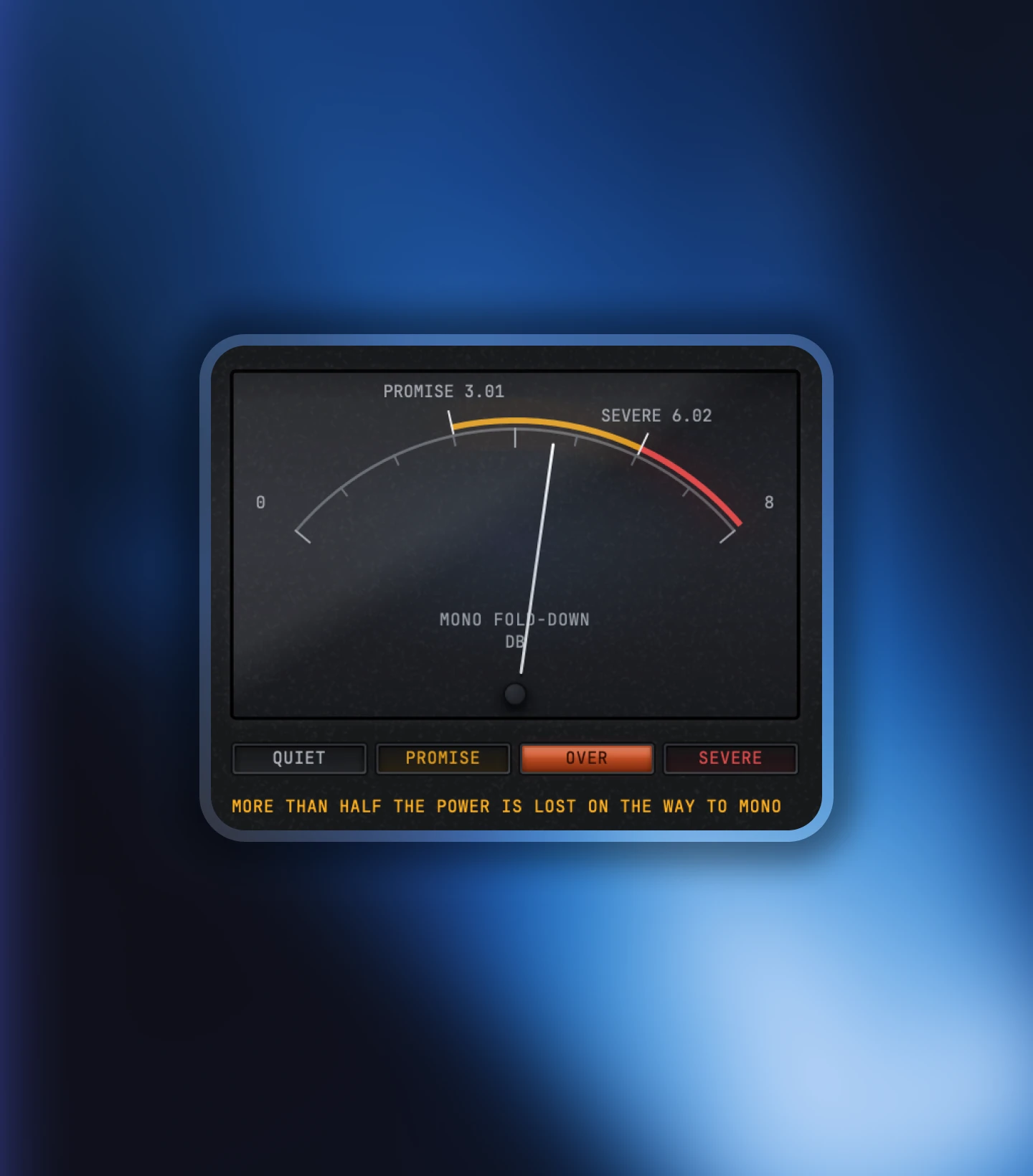
It measures the broadband mono fold-down loss at the plug-in's own output and prints it in dB, against two lines: 3.01 dB, where half the power goes, and 6.02 dB, where three quarters of it does.
Three bands
A width control for the low, mid and high band, with the crossovers under your hand. The low band stops at unity and the stop is on the parameter, so your host, your preset and your automation lane can all see it.
Delta, mono and solo
Hear the difference the plug-in is making, hear the mono fold the needle is measuring, or hear one band's mid or side on its own. None of the three can move the reading.
Mono fold-down
It does not fix the fold-down for you and it never hides it
A club system, a phone speaker and half the rooms your record will be played in sum your mix to mono, and what survives that sum is the mid signal. This plug-in measures what is lost, continuously, at its own output, and prints the figure in dB while you keep both hands on the width. It does not pull the width down on your behalf.
- 3.01 dBThe first printed line. At that rung broadband correlation reaches zero and half the power is gone to the mono sum.
- 6.02 dBThe second. Three quarters of it is gone.
- The readingIt moves the moment the mix moves, because it is measured and not predicted. And it is measured after the plug-in, so it is always the figure for what you are actually sending out.
- No guardAn earlier version pulled the width down by itself and it was measured back out. Warning was judged better than silent correction, and that decision is final.
Width
The low band stops at unity, and the stop is somewhere you can see it
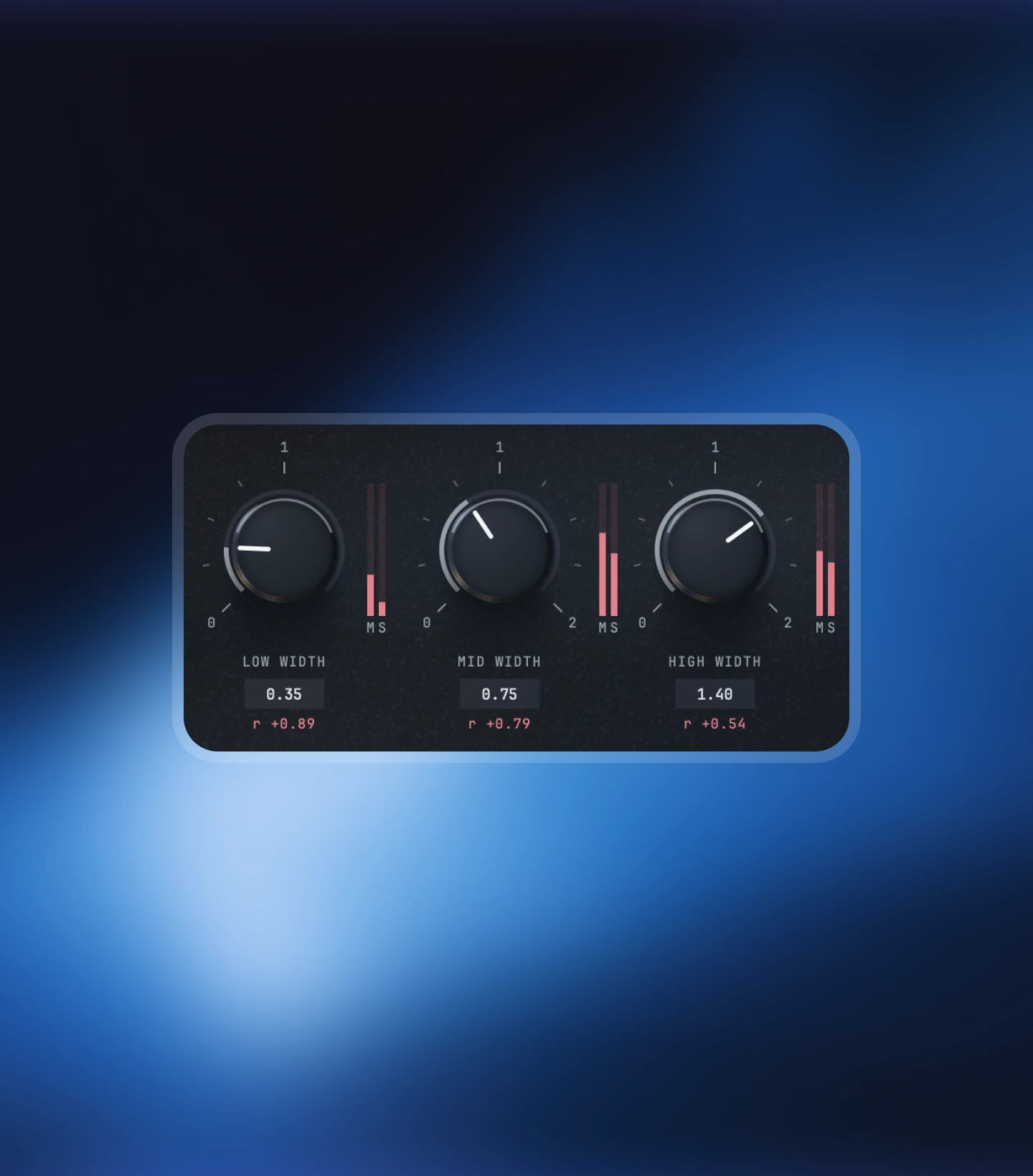
Three bands, each with its own width control, and two crossovers under your hand. The low band cannot be pushed past unity and that ceiling sits on the parameter itself, decided before any audio arrives, rather than as a clamp buried in the engine that a wide automation curve would hit silently. It is the only real protection this plug-in carries, and it is the one your host can read.
- WidthZero is mono, one is unchanged, two is twice the side level. Linear in the ratio itself, so the centre detent lands in the middle of the control.
- Low widthThe same control with its top at one. It cannot go wide, by design.
- CrossoversThe low one runs 40 Hz to 400 Hz and opens at 120. The high one runs 800 Hz to 8 kHz and opens at 2500. They are held at least 100 Hz apart.
- ResolutionThe low crossover is skewed so it resolves single hertz near its bottom, which is where the mono decision is actually made.
Compared
Where IMAGER sits, and where it does not
Checked against each maker's own product page in September 2026, except where the maker's site would not answer and a dealer did. Numbers only, and the rows IMAGER loses are in the table too.
| Measured | IMAGER | Ozone Imager | Waves S1 | bx_control V2 |
|---|---|---|---|---|
| Width bands | 3 | 1 | 1 | not measured |
| Mono fold-down loss, in dB | Yes, continuous | No, three vectorscopes | not measured | not measured |
| Printed threshold lines | 3.01 dB and 6.02 dB | No | No | No |
| Low band capped at unity | Yes, on the parameter | No | No | not measured |
| Delta listening | Yes | No | No | not measured |
| Solo one band's mid or side | Yes, 6 taps | No | No | not measured |
| Automatic width correction | No, by decision | No | No | not measured |
| Light and dark themes | Yes | not measured | not measured | not measured |
| Formats | VST3, AU, Standalone | AU, AAX, VST2, VST3 | not measured | not measured |
| Price | $49 | Free | $129 list, $29.99 today | $50 list, $19.99 today |
The free row in this table belongs to the company that leads this category, and it is printed for the same reason the rest are: a spec sheet you cannot lose an argument with is not a spec sheet.
Product details
Technical specs
The practical details, organized for a quick scan.
Engine
Signal
- Bands3: low, mid and high
- Width0.00 to 2.00, linear in the ratio
- Low band ceiling1.00, on the parameter
- Low crossover40 Hz to 400 Hz, opens at 120 Hz
- High crossover800 Hz to 8 kHz, opens at 2500 Hz
- Crossover spacingHeld at least 100 Hz apart
- ProcessingNo AI, no learning, no analysis pass
Metering
What it tells you
- Mono fold-downMeasured continuously at the plug-in's output, printed in dB
- Printed lines3.01 dB and 6.02 dB
- CorrectionNone. The plug-in prices the loss, it does not remove it
- ListeningDelta, mono fold, and solo on any band's mid or side
- Controls9, published to the host
License
What you get
- Price$49
- ActivationOnline activation through the Nolvra Hub, 2 machines
- Trial7 days, no card
- In the planIncluded in Nolvra All-Access
- CancellingAccess to the end of the period
Platforms
System support
- Version0.8.8
- Installer6.1 MB (macOS) · 5.4 MB (Windows)
- FormatsAU, VST3 and Standalone, 64-bit
- macOS11 or later, Apple Silicon
- WindowsVST3 and Standalone, 64-bit
- ThemesLight and dark, the same geometry in both
- ManagerNolvra Hub
- UpdatesThrough Hub
Available for macOS and Windows. On Mac it needs Apple Silicon; on Windows it is a 64-bit app. VST3 and AU on Mac, VST3 on Windows. Full system requirements
Setup flow
From checkout to session
Three steps, then IMAGER is ready inside your DAW.
Buy it
Buy once, or get it with Nolvra All-Access.
Install from Hub
The Nolvra Hub installs it and keeps it updated. Two machines.
Put it on the mix bus
Set the crossovers, move the width, and watch the needle.
FAQ
Before you buy
There is a well known free stereo imager. Why pay for this one?
Because they answer different questions. The free one draws your stereo field, with three vectorscope meters, and a picture is read by interpretation. IMAGER prints a number: the mono fold-down loss in dB, measured continuously at its own output, against two lines drawn where half and three quarters of the power go. It also splits the signal into three bands where the free one has a single width control. Both facts are in the comparison table on this page, and so is the free price.
Does it fix the mono problem for me?
No, and that is a decision rather than a gap. An earlier version carried an automatic guard that pulled the width down when a band went out of phase, and it was measured out of the product: it moved the level most where it helped least, 3.84 dB of movement to buy 0.75 dB of fold-down on one mix, against 0.55 dB of movement where it bought 3.45 dB. Warning was judged better than silent correction and that decision is final. The cost is honest: without the guard this plug-in can break its own 3 dB line on real material, and it tells you while it happens.
Why can the low band not go wider than unity?
Because widening the low end is where mono fold-down damage usually comes from, and the ceiling is the only real protection this plug-in carries. It sits on the parameter rather than inside the engine, which means it is decided before any audio arrives and your host, your presets and your automation lane can all see it. A wide automation curve cannot hit it silently.
What do DELTA, MONO and SOLO do?
DELTA plays the output minus the same signal at unity width, so you hear exactly what the knobs did and nothing else, and with the bypass engaged it is zero by arithmetic. MONO folds the output down with the same sum the needle measures. SOLO puts one band's mid or one band's side on its own, six taps, one at a time. None of the three can change the reading, because the monitor section sits after the needle's tap.
Which formats and which systems?
AU, VST3 and a standalone app on macOS 11 or later, Apple Silicon, and VST3 and a standalone app on 64-bit Windows. It ships with a light theme and a dark one, and the geometry is identical in both.
How many machines does one licence cover?
Two. Activation goes through your Nolvra Hub account, and if you cancel a subscription your access runs to the end of the period you paid for.
Is it included in All-Access, and is there a trial?
Yes to both. IMAGER is one of the plugins All-Access covers, and the 7-day trial opens it with no card. The trial is for plugins: sample packs open with a purchase or a membership.
Start with IMAGER
Get IMAGER
How much of the mix goes missing when it folds to mono, in dB, while you keep both hands on the width.
$49