
 Sound designVocals
Talkbox Versus Vocoder
Both make an instrument talk. One uses your mouth as the filter, the other uses your voice as a control signal.
Sound designVocals
Yes, free talkbox plugins exist. Five that install today, what each one actually does, and the routing and feature gaps their download pages skip.
The question people actually type is whether a free talkbox plugin exists at all, and the answer is yes: five install and run on a current machine. The catch used to be that none of them was a talkbox. Three of the four older ones are vocoders carrying the word talkbox in their listing, and the fourth never touches your voice. Below is each one, measured from its own product page: what it does, where it runs, whether anyone still updates it, and what it leaves out.
mda gives Talkbox away in VST, VST3 and Audio Unit for macOS and Windows. On Mac the VST2 build is Intel and the Audio Unit is a Universal 2 binary, so Apple Silicon users are steered to the AU. Its own KVR listing calls it a high resolution vocoder rather than a talkbox. What it leaves out is a carrier. It wants two signals, synth and voice, on the two halves of one stereo input: a bus with one source panned hard left and the other hard right. KVR threads have been explaining that routing since 2005. No scale, no harmony. Its last SourceForge release is dated January 2021.
TAL Software lists TAL-Vocoder as free in VST, VST3, Audio Unit, AAX and CLAP, on Windows, macOS and Linux, at version 3.0.4, with 3.0.3 dated August 2023. That makes it the most actively maintained entry here, and it removes the routing problem: there is a synth inside it, a VCO with saw, pulse, sub oscillator and noise, poly or mono with portamento. A MIDI part drives the carrier. What it leaves out is the talkbox itself. Eleven bands is a filter bank, and a filter bank reads as early eighties synth pop, not as a tube in somebody's mouth. Nothing on its page mentions harmony voices.
g200kg released Vocovee in September 2008 as a free VST effect and it sits at 1.0.5. It carries an eight voice, three oscillator, two LFO synth as its carrier, a six band graphic EQ, and delay, chorus and reverb on the output, which is more signal path than anything else here gives away. What it leaves out is half the market: a VST for Windows, no macOS build, no VST3. On an Apple Silicon machine it is not a candidate at all.
Plogue lists Alter/Ego as free, as standalone, VST, VST3 and AAX on Windows and macOS with an Audio Unit on Mac, and it appears in nearly every free talkbox roundup. It is a real time singing synthesizer: you type lyrics, play a MIDI keyboard, and it sings them. Your own voice never enters the plugin. Worth knowing before you download it expecting to sing through something, and worth knowing afterwards, because as a synthetic vocal source it is interesting on its own terms. Plogue keeps it under Legacy.
The list is short because the two effects are built differently, and a talkbox and a vocoder are not the same instrument. A vocoder is an analysis problem: split the voice into bands, read the levels, apply them to a carrier. That is well understood code, and free ones are everywhere. A talkbox is acoustic: a driver pushes sound up a tube into a real mouth, and the mouth shapes it. Modelling that means formants that slide as the jaw moves, not levels in fixed bands, and free plugin authors have largely not gone there.
So the free options fall into two piles: vocoders that need you to supply a carrier track, and vocoders that ship a synth instead. Neither pile holds what producers keep asking for in forum threads, which is something you sing into.
There is now a fifth free entry, and it is ours: PRISM MINI is a free talkbox plugin with the carrier inside it. No second track, no bus, no carrier to load. It is a talkbox rather than a vocoder, which is what the four above are missing, and it is free with a Nolvra account rather than free for a trial period: no time limit, no feature locks. Ten controls on the face, four factory presets, and your own presets on top.
PRISM PRO is the paid one, and the difference between them is not sound. The engine is the same. What the paid plugin adds is the part that decides notes: up to three harmony voices, a key and scale lock the lead and the harmony both pass, chord detection from the sidechain, and the compressor and chorus chain at the end of the wet path.
The PRISM MINI product page carries the specifications for the free one and the PRISM PRO page for the paid one. Test either the way you should test the four above: one vocal, one part, one evening.
Compared
Every entry below installs today and costs nothing. What separates them is not sound quality, it is what each one asks of you before a word comes out shaped, and until 2026 none of the free ones was a talkbox. Checked against each maker's own page and listing in August 2026.
| Plugin | Price | What it actually is | Carrier | Formats and platforms | Last release |
|---|---|---|---|---|---|
| Nolvra PRISM MINI | Free with a Nolvra account | A talkbox, not a vocoder. Ten controls on the face and four factory presets | Inside. The engine takes the pitch from the voice it hears | AU and VST3 on macOS 14 or later, Apple Silicon | Version 1.0.5 |
| mda Talkbox | Free | Its own KVR listing calls it a high resolution vocoder | You supply it. Two signals on the two halves of one stereo input | VST, VST3 and AU, Windows and macOS. The VST2 build is Intel, the AU is Universal 2 | January 2021 |
| TAL-Vocoder | Free | An eleven band vocoder with a synth inside | Inside. A VCO with saw, pulse, sub and noise, driven by MIDI | VST, VST3, AU, AAX and CLAP, Windows, macOS and Linux | Version 3.0.4, 3.0.3 dated August 2023 |
| Vocovee | Free | A vocoder with an eight voice, three oscillator synth and an output chain | Inside. Eight voices, three oscillators, two LFOs | VST only, Windows only. No VST3, no macOS build | Version 1.0.5, released September 2008 |
| Plogue Alter/Ego | Free | A real time singing synthesizer. It does not process your voice at all | Not applicable. It sings on its own | Standalone, VST, VST3 and AAX on Windows and macOS, plus AU on Mac | Kept under Plogue's Legacy page |
| Nolvra PRISM PRO | $99 once, or included in All-Access at $14.99/month | A talkbox, not a vocoder, with up to three harmony voices | Inside. The engine takes the pitch from the voice it hears | AU and VST3 on macOS 11 or later, Apple Silicon. VST3 on 64-bit Windows | September 2026 |
Three of the four free entries are vocoders and the fourth never listens to you, so the column that decides the session is Carrier. If nothing lives inside the plugin, your first move is a bus with one source panned hard left and the other hard right, before you know whether the phrase works at all.

PRISM PRO keeps the carrier inside the plugin and locks its harmony voices to a scale. Seven day trial, no card, plugins only.
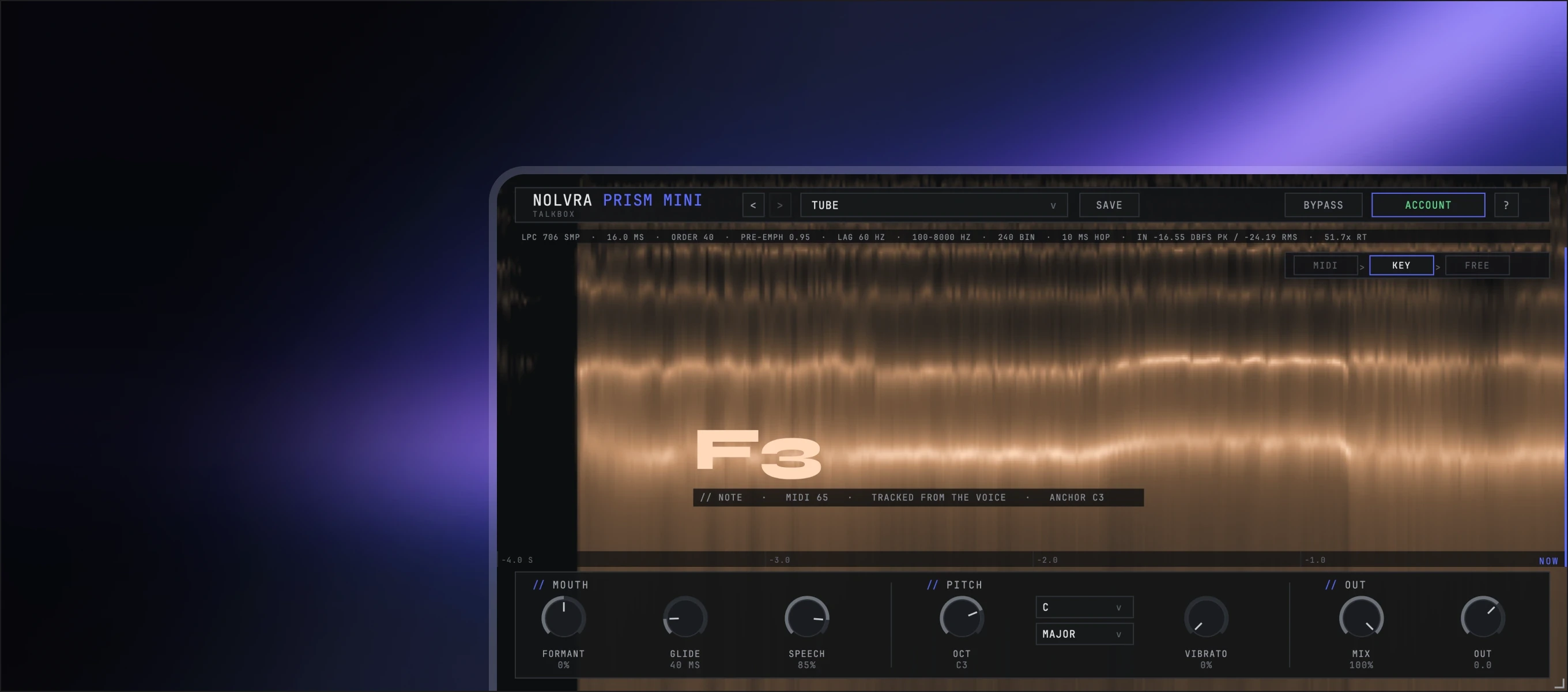
A talkbox with the carrier inside, free through the Nolvra Hub.
Yes, five of them install and run on a current machine: PRISM MINI, mda Talkbox, TAL-Vocoder, Vocovee and Plogue Alter/Ego. Read the listings carefully, though. Three of the four older ones are vocoders carrying the word talkbox in their listing, and one is a singing synthesizer that never processes your voice at all.
mda's own listing gives an Audio Unit built as a Universal 2 binary, so that is the build Apple Silicon users are pointed at; the VST2 build is Intel. Its last SourceForge release is dated January 2021, and forum threads asking for a 64-bit Mac build have stayed open since 2024, so test it in your own host before you plan a session around it.
It depends on the carrier. mda Talkbox has none of its own: it wants a synth and a voice on the two halves of one stereo input, which means a bus with one source panned hard left and the other hard right. TAL-Vocoder and Vocovee both carry a synth inside, so they need no second track, but neither of them is a talkbox.
Because the two effects are built differently. A vocoder is an analysis problem: split the voice into bands, read the levels, apply them to a carrier. That is well understood code and free ones are everywhere. A talkbox is acoustic: a driver pushes sound up a tube into a real mouth. Modelling that means formants that slide as the jaw moves rather than levels in fixed bands, and free plugin authors have largely not gone there.
All four here are free downloads rather than trial periods. Free is a crowded word in this category, though: roundups regularly list plugins that are free only for the length of another product's trial, and some free builds interrupt the signal until you register. Two things worth checking before you build a track on one: whether there is a time limit, and whether any feature is locked.
Guides
You may also like
Sound designVocalsBoth make an instrument talk. One uses your mouth as the filter, the other uses your voice as a control signal.
 VocalsSound design
A talkbox plays a carrier through the shape of your mouth. What that means inside a plugin, and why you do not have to load a synth first.