
 MixingEQLow end
Why Does My Mix Sound Muddy? Find It In The Numbers First
Mud is too much energy in the low mids, or too many parts sharing the same low octave. Measure where the build-up actually is before reaching for an EQ.
MixingEQLow end

The sweep and boost trick finds notes as easily as it finds resonances. What actually separates the two is time, and that changes how you should hunt.
A vocal resonance is a frequency that rings the same way whatever note is being sung. It comes from the room, from a cheap microphone, from a hollow in the singer's own throat, or from a corner of the booth that happens to be a certain distance across. It sounds like hardness on one word and nothing on the next, it survives compression, and it gets worse the louder the singer gets. Almost every guide to removing resonances from vocals starts the same way: sweep a narrow boosted bell until something screams. That works, and it is also the reason so many vocals end up with three cuts that were never resonances at all.
Put a narrow bell at plus twelve decibels anywhere in a vocal and something will scream. That is what a narrow boost does: it makes whatever is at that frequency intolerable, whether the thing there is a room mode or the third harmonic of the note the singer is holding.
The problem is that a resonance and a note look identical to the tool you are using to hunt with. Both are narrow peaks standing well above their surroundings. When that hunt was measured across twenty seven real mixes, stems, takes and drum loops, the ordinary musical content stood between thirteen and thirty seven decibels above its own neighbourhood, which is more than a deliberately planted ring managed in the same material. There is no loudness threshold that separates them, and raising the bar just makes you deaf to the thing you were looking for.
So the sweep is not wrong. It is under specified. It tells you where energy is concentrated and then leaves the hardest part, deciding whether that concentration is a fault or the music, entirely to you at the moment when your ear is least reliable because you have been listening to a screaming filter for a minute.
Music moves. A melody walks up a scale, a phrase resolves, a singer changes register. A resonance does none of that. It sits at one frequency for as long as the source that causes it is in the room, which is usually the entire take.
That difference is measurable and it is large. Across seven hundred and thirty six frequencies tracked in that same corpus, ordinary musical content held one pitch for a median of one and a quarter seconds, and even at the ninety ninth percentile it held for under thirteen. A planted ring in the same material stayed up for between fifteen and fifty five seconds. The two populations barely overlap, which is exactly what you want from a test.
This is why the practical advice below is built around listening for longer rather than boosting harder, and it is also the principle RIDGE works on: the scan watches a five second window and reports a frequency only once it has stayed through enough of it.
Play the full performance before you touch an EQ. You are listening for the sound that is present on every line rather than for the worst moment. A harshness that appears only in the chorus is a level problem or an arrangement problem, and the 2 to 5 kHz range has its own article because that particular one is usually neither a resonance nor an EQ fix.
Use a narrower boost than you think and half the gain. At plus twelve everything screams, so you learn nothing. At plus six only the genuinely prominent things do, and you will find you have three candidates instead of nine.
Park the boost on a candidate and let a full verse play. If the offence tracks the melody, it is a note and you are about to cut a note. If it stays put while the singing moves, it is a resonance. This step takes twenty seconds a candidate and it is the one everybody skips.
A static cut removes the frequency for the whole song, including the lines where nothing was wrong. Set the band to sit flat and pull down only when that frequency gets loud, and the vocal keeps its body on the quiet lines. Start at three decibels of range and see whether you can hear it at all before you go further.
Resonances are always more obvious soloed than in context, which is how people talk themselves into six decibel cuts that leave the vocal thin behind a beat. If it is fixed in the mix, it is fixed. The order you build a vocal chain in decides how much of this you will even need.
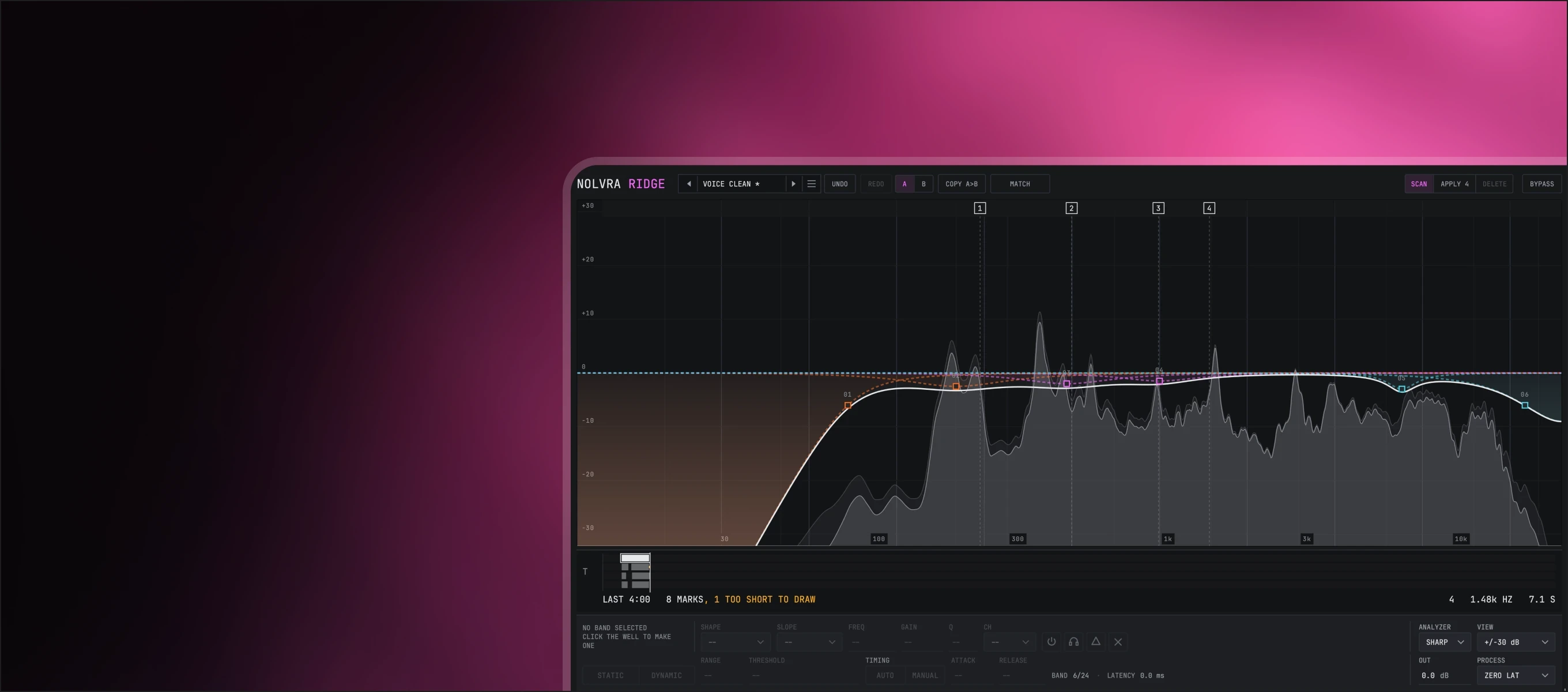
RIDGE listens to the take, marks up to eight resonances and shows you when each one was there, then writes a band that only moves while the frequency rings.
Hold a narrow boost on the frequency and let a full phrase play. A note moves with the melody and a resonance stays at the same frequency while the singing moves around it. Loudness alone will not tell you, because ordinary sung notes measure just as prominent above their surroundings as a genuine ring does.
Before, in almost every case. A compressor reacts to the loudest thing in the signal, so a resonance that is still in the track pulls the whole vocal down every time it rings, which is audible as pumping on one syllable. Take it out first and the compressor sees the performance instead.
Less than feels right while soloed. Start around three decibels and judge it in the mix rather than on its own. A dynamic cut that only engages while the frequency rings can be gentler than a static one and still solve the problem, because it is not removing anything on the lines that were fine.
Guides
You may also like
MixingEQLow endMud is too much energy in the low mids, or too many parts sharing the same low octave. Measure where the build-up actually is before reaching for an EQ.
 MixingEQ
The range that makes a mix sound loud is the range that makes it hurt. Keep the presence and lose the fatigue.