
 MixingVocalsEQ
How To Remove Resonances From Vocals
The sweep and boost trick finds notes as easily as it finds resonances. What actually separates the two is time, and that changes how you should hunt.
MixingVocalsEQ
All three turn something down only while it is too loud. What differs is who picks the frequency and what sets it off, and that decides which to use.
A de-esser, a dynamic EQ and a resonance suppressor all do the same thing in one sentence: they turn part of the sound down only while it is too loud. That is why they get recommended for the same problem in the same forum thread. They are not interchangeable. What separates them is who decides where the cut happens, what sets the cut off, and how many places it can work at once. Get those three right and the choice is quick.
A de-esser watches one region, usually somewhere between 4 and 10 kHz where S and T sounds live, and turns down when that region gets louder than a threshold. Depending on the design it turns down just that region or the whole signal for a moment. It is one detector and one decision, aimed at one kind of sound.
A dynamic EQ is an equaliser whose bands can move. You place each band, choose its frequency, width and threshold, and the band cuts or boosts only while its own region crosses that level. It does exactly what you set and nothing else, which is its strength and its cost: you have to know where the problem is. RIDGE adds a scan that listens to a take and marks the resonances it finds, then writes a band for each one, but the bands are still yours to keep, move or delete.
A resonance suppressor does not have bands in that sense. It analyses the spectrum in fine slices, compares every slice with its neighbours, and turns down whatever stands out and rings, wherever that is and for as long as it lasts. You decide how much, how narrow and how choosy it is, and where it is allowed to listen. It decides the frequencies. GLOAM works this way, with a focus range from 20 Hz to 20 kHz and a five band sensitivity curve that makes it react sooner or later in a region.
Compared
General behaviour of each class, not a test of any one product. The GLOAM and RIDGE figures come from their own specifications.
| Question | De-esser | Dynamic EQ | Resonance suppressor |
|---|---|---|---|
| Who picks the frequency | You, roughly: one region | You, exactly: every band | The plugin, inside the range you allow |
| What sets off a cut | That region crossing a threshold | Each band crossing its own threshold | A slice standing out from its neighbours |
| How many places at once | One | As many as you placed. RIDGE has 24 bands | Anywhere in the focus range |
| Latency | Usually none or very little | Often none. RIDGE processes at zero latency in this release | Some, because it analyses ahead. GLOAM reports 1024 to 4096 samples |
| Best at | S and T sounds | A known problem you want under exact control | Many narrow rings that move from line to line |
Most chains that sound finished use two of the three, each on the job it is good at.
Listen to the worst section and describe it in one word. Spitty, whistling, boxy, nasal, glassy. The word usually picks the tool before any plugin is open.
If the problem is the S, the T and the SH, a de-esser is the simplest answer because it is built for exactly that event. A suppressor can soften sibilant resonance too, but a de-esser does it with one threshold and no guessing.
If you can point at the problem, a boxy 400 Hz on the chorus or one whistle at 3.2 kHz, a dynamic band gives you exact control and stays still when the problem is absent. If you would rather not sweep for it, a scan that finds resonances by time rather than loudness does the hunting first.
If the harshness moves around, several narrow peaks that change with every line or every hit, placing bands turns into chasing them. That is the case a suppressor exists for. Set its focus to the region that hurts, keep the depth light, and listen to what it removes. A full pass on a harsh vocal walks through it.
Each tool has one typical failure, and knowing it is most of the skill. A de-esser set too low starts catching consonants that were not sibilant, and the singer sounds as if they have a lisp. A dynamic EQ fails quietly: a band placed a few hertz off the real problem moves on every line and fixes nothing, and the session gains a cut nobody needed. A resonance suppressor fails by doing too much. Pushed deep across the whole range, it smooths every peak, including the ones that made the vocal sound present, and the result is clean and lifeless. The check is the same for all three. Listen to what is removed, in context, at matched level, and stop when the problem stops drawing attention rather than when it disappears.
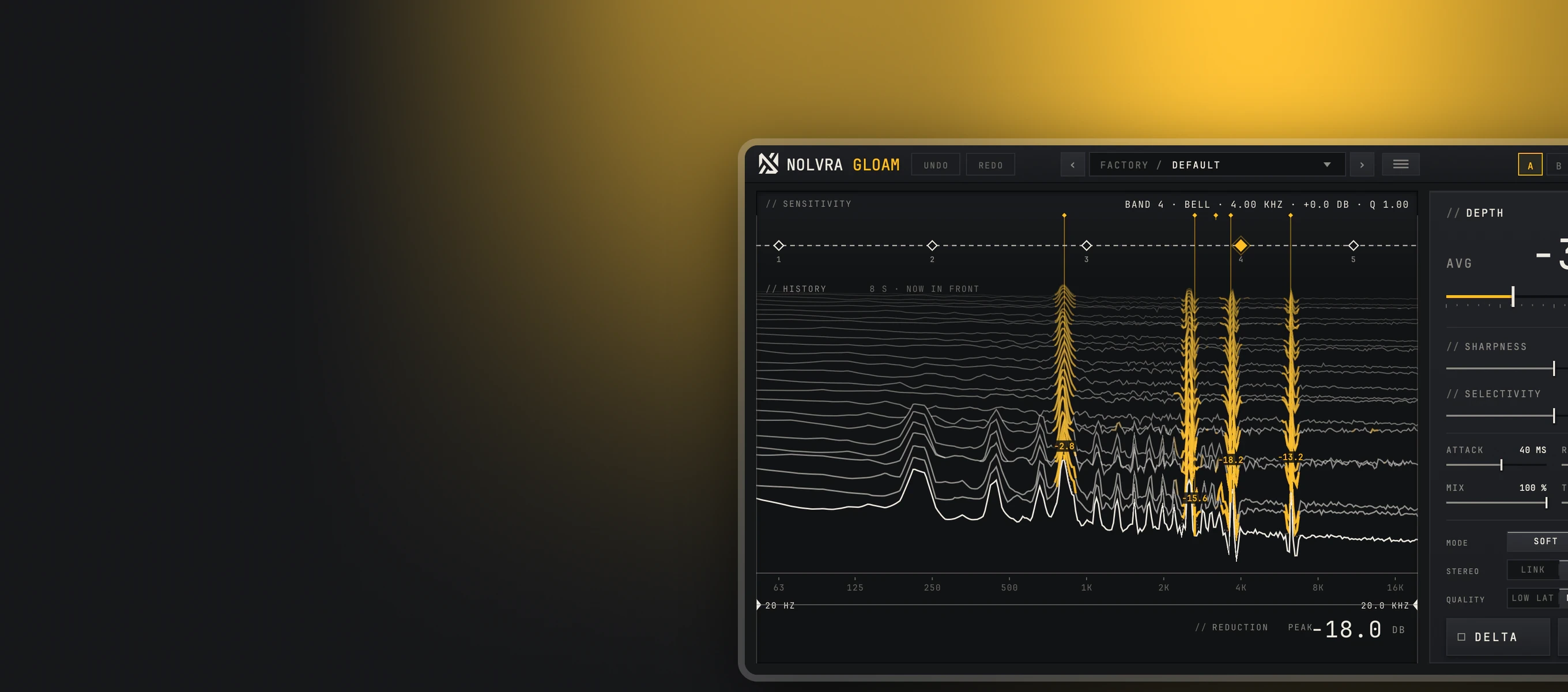
GLOAM is a free resonance suppressor. It finds the ringing frequencies by itself and turns each one down only while it rings, on Mac and Windows.
No. A dynamic EQ cuts where you placed a band and nowhere else. A resonance suppressor decides the frequencies itself, by comparing each part of the spectrum with its neighbours, and can work in many places at once inside the range you allow.
Sometimes, on mild sibilance, but a de-esser is the simpler tool for S and T sounds because it is aimed at exactly that event. Many vocal chains use a suppressor early and a de-esser after compression.
Most do, because they analyse the spectrum ahead of the cut. GLOAM adds 1024, 2048 or 4096 samples depending on its QUALITY setting and reports it to the host, so playback stays in time. A dynamic EQ or a de-esser often adds none.
Yes. GLOAM is free on Mac and Windows with no account and no licence key, and the other free options are compared in our list of free alternatives.
Guides
You may also like
MixingVocalsEQThe sweep and boost trick finds notes as easily as it finds resonances. What actually separates the two is time, and that changes how you should hunt.
 MixingEQVocals
Seven free plugins suggested instead of soothe, checked on each maker's own page: which are really suppressors, which are really free, and what they need.