Is there a free alternative to soothe2?
Yes, and GLOAM is one built for that job. soothe2 from oeksound, and soothe3 that replaced it, are paid plugins that find resonances and turn them down dynamically. GLOAM is a free resonance suppressor in the same class: it watches the spectrum, finds the frequencies that stand above their neighbours and ring, and reduces each one only while it rings, so the rest of the take keeps its level. It is free with no account, no license key and no time limit, and it runs as VST3 on Windows 10 or later and as VST3 and AU on an Apple Silicon Mac with macOS 11 or later. It is not a copy of anybody's plugin and we do not claim it sounds the same as one.
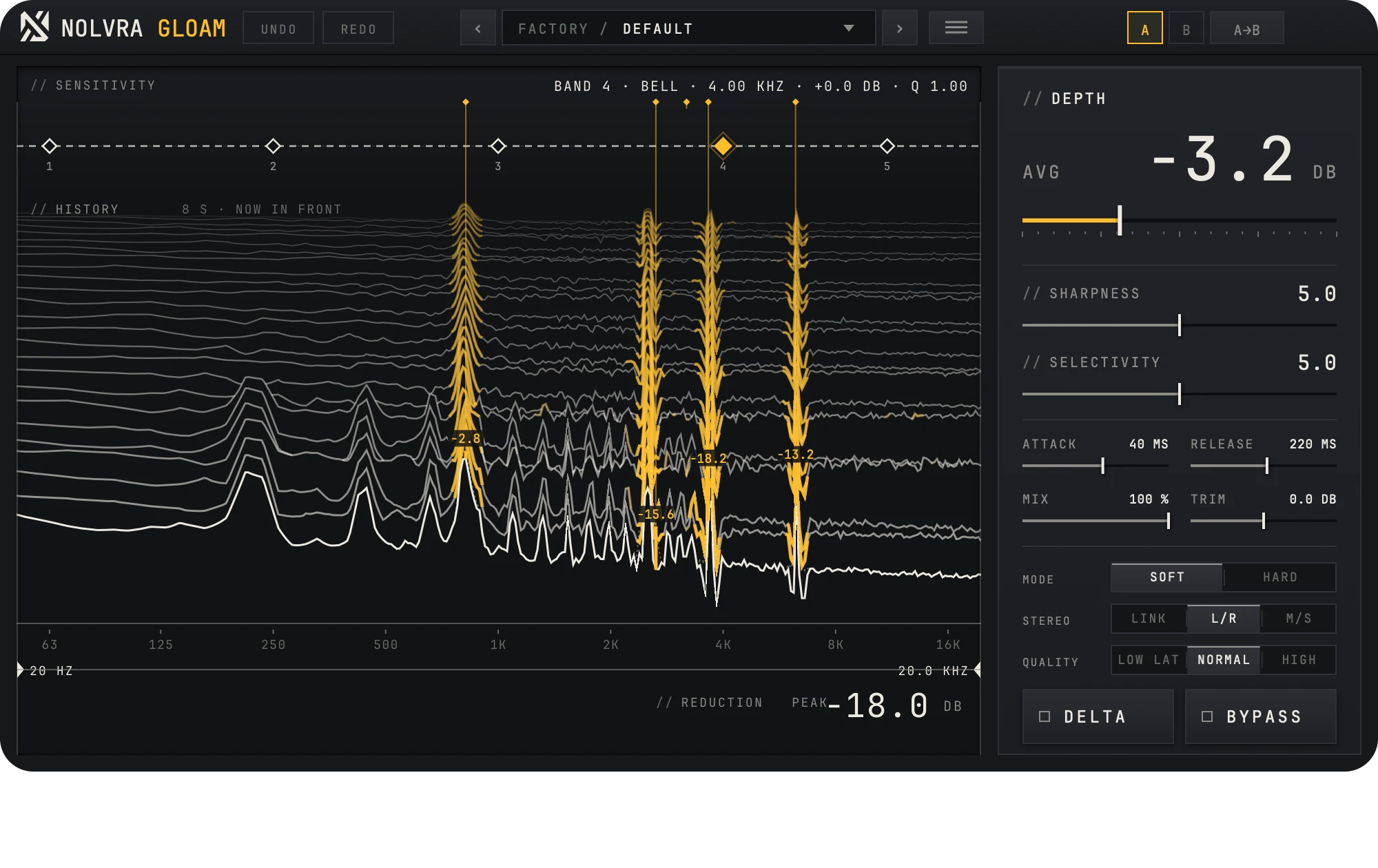
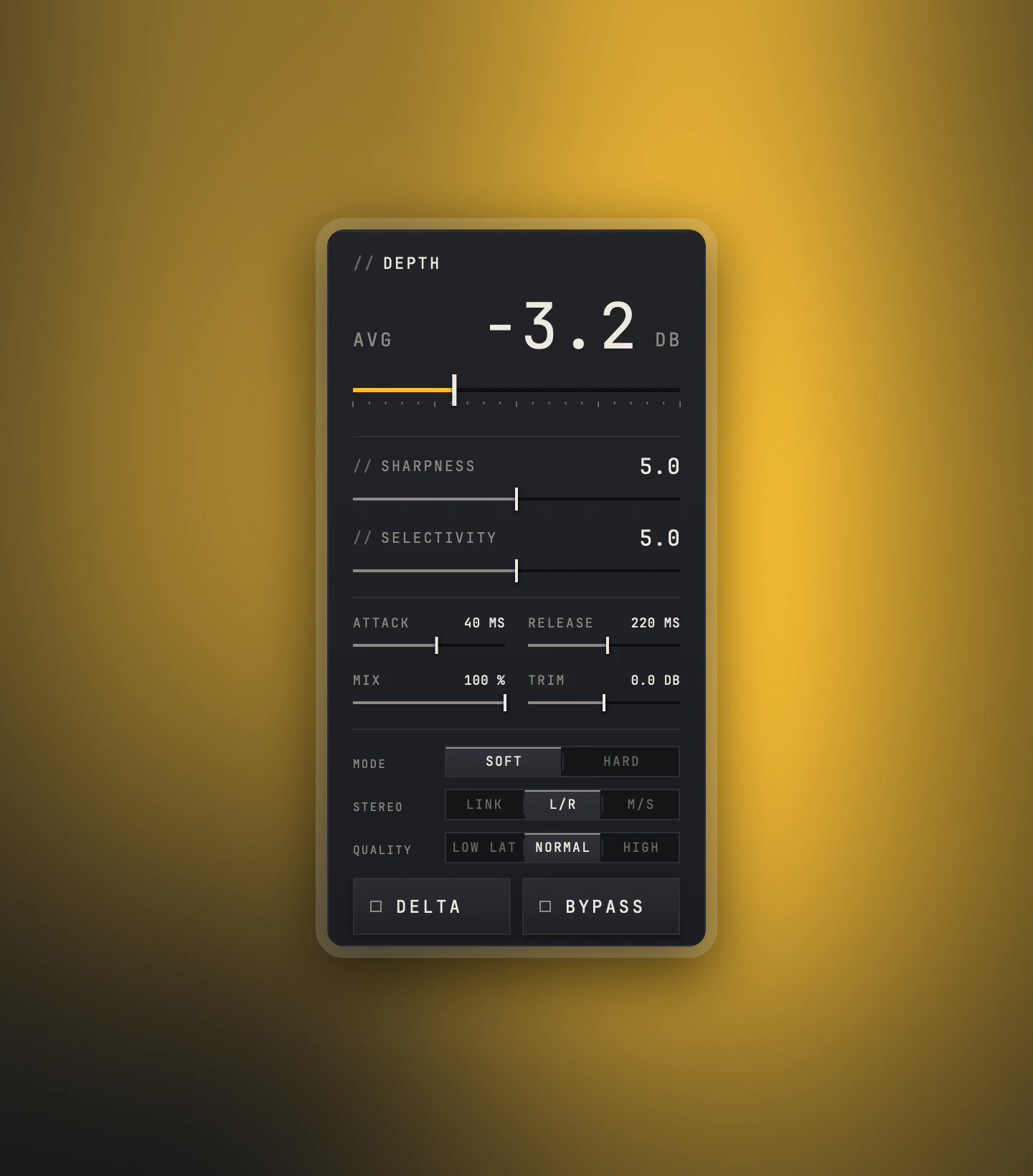
The controls are on the face and none of them is locked. DEPTH sets how far it may cut and reads the average cut in dB. SHARPNESS sets how narrow the cuts are and SELECTIVITY how prominent a peak has to be before it is touched. ATTACK and RELEASE set how fast a cut arrives and lets go. MODE switches between SOFT and HARD, STEREO between L/R, LINK and M/S, and QUALITY between three resolutions with their latency reported to the host. A five band sensitivity curve and two focus handles decide where it listens. DELTA plays only what it removes. Two things are protected by design: a sung note, which arrives as a series of harmonics, and a steady tone under 250 Hz, which is how an 808 or a held sub reads, so it does not hollow out the low end.
How it works
One insert, and it does the sweep for you
Sweeping a narrow boost to find the frequency that rings is the same few minutes on every track. GLOAM listens for it all the time.
Insert it on the harsh track
A vocal, a hi-hat bus, a guitar, the mix bus. It opens at a light setting that is already doing something.
Set the depth by ear
DEPTH sets how far it may cut. The readout is the average cut in dB, so the number means what you hear.
Hear what it takes
DELTA plays only what GLOAM removes. If you hear the singer in it, you have gone too far.
Listen
It tells a ring from a note
A ring stands above its neighbours and flickers like noise. A sung note brings a series of harmonics with it, and a held 808 is a steady tone. GLOAM turns down the first and leaves the other two alone, so a bright vocal keeps its pitch and the low end keeps its sub.
- HistoryThe last eight seconds, newest in front
- FocusTwo handles, 20 Hz to 20 kHz
- SensitivityFive bands on the display, ±12 dB
- PeakThe deepest cut right now, in dB

Shape
Twelve controls, none of them locked
The rail beside the display holds all of them, from DEPTH at the top to BYPASS at the bottom. DEPTH reads the average cut in dB, so the number means what you hear.
- Depth · Sharpness · SelectivityHow much, how narrow, how choosy
- Attack · Release · Mix · TrimHow fast it cuts and lets go, blend and level
- Mode · Stereo · QualitySoft or Hard, L/R, Link or M/S, three resolutions
- Delta · BypassHear what it takes, then what you had
Compared
GLOAM compared to the free resonance tools
The free plugins producers are pointed to when they search for a soothe alternative, and what each one actually does. Checked against each maker's own page in November 2026.
| Plugin | Price | What it actually is | Finds the problem |
|---|---|---|---|
| Nolvra GLOAM | Free. No account, no key, no time limit | An automatic resonance suppressor with a focus range and a five band sensitivity curve | By itself, across the focus range |
| CRQL ANINA | Free, donation optional | Spectral resonance suppression that can also isolate the resonances | By itself |
| Mercurial Tones Dagon | Free, claimed to an account | Resonance and volume control with five detection modes | By itself |
| Tokyo Dawn Labs TDR Nova | Free | A parallel dynamic EQ with four dynamic bands | You place the bands |
Three of the four find the resonances themselves and one waits for you to place a band, so the column that decides the session is the last one. GLOAM is the entry that asks for nothing before it runs: no account, no key and no activation.
Product details
Technical specs
The practical details, organized for a quick scan.
Engine
Signal
- TypeAutomatic resonance suppressor
- Depth0 to 100 %, default 31 %, read as average cut in dB
- Sharpness0 to 10, default 5
- Selectivity0 to 10, default 5
- Attack5 to 200 ms, default 40 ms
- Release40 to 1000 ms, default 220 ms
- ModeSoft · Hard
- StereoL/
R · Link · M/ S - Focus20 Hz to 20 kHz, two handles
- Sensitivity5 bands, ±12 dB
- Mix · Trim0 to 100 % · ±12 dB
- ListenDelta · Bypass
- Latency1024, 2048 or 4096 samples by Quality, reported to the host
- Controls12 on the rail, none locked
Build
What you install
- Version1.0.0
- Installer8.6 MB (macOS) · 4.0 MB (Windows)
- Presets23 factory in 7 folders, plus your own
- CompareA/
B · Undo · Redo - WindowScales from 75 % to 200 %, size remembered
- FormatsAU/
VST3 (macOS) · VST3 (Windows) - Architecture64-bit
- macOS11 or later, Apple Silicon
- Windows10 or later, x64
License
Free, no account
- PriceFree
- AccountNone
- License keyNone
- Time limitNone
- Feature locksNone
- PlanNot part of All-Access or the Collection
Available for macOS and Windows. On Mac it needs Apple Silicon; on Windows it is a 64-bit app. VST3 and AU on Mac, VST3 on Windows. Full system requirements
Setup flow
From this page to the track
Three steps, and nothing to sign in to.
Download
Download the installer for your system from this page.
Install
On macOS it installs the VST3 and the AU for your user only, no administrator password. On Windows only VST3 is installed.
Open it in your DAW
Rescan plugins and look for Nolvra GLOAM. It opens on its default and is already working.
FAQ
Before you start
Is GLOAM really free?
Yes. There is no account, no license key, no activation and no time limit, and every control is open. It is not part of All-Access or the Collection because it does not need to be.
What does a resonance suppressor do?
It finds frequencies that stand out from their neighbours and ring, usually the hard, whistling or boxy ones, and turns each one down only for as long as it rings. A static EQ cut stays in for the whole song; this moves with the material.
Will it dull my vocal?
Not at its default, which is deliberately light. If a vocal starts to sound dull, lower DEPTH or raise SELECTIVITY, and switch on DELTA: if the part you hear in it sounds like the singer rather than the harshness, it is taking too much.
Does it add latency?
Yes. It looks ahead to find a ring before it cuts it, which costs 1024, 2048 or 4096 samples depending on QUALITY. The plugin reports that to the host, so the track stays in time on playback. It is a mixing tool rather than one to monitor through while recording.
Will it cut my 808?
It is designed not to. A steady tone under 250 Hz, which is how an 808 or a held sub note reads, is treated as a note rather than a ring. Ringing room boom in the same range is still reduced.
Which DAWs does it run in?
Any host that loads VST3 on Windows, and VST3 or AU on macOS. We opened and checked it in Ableton Live 12 on macOS and Windows.
Further reading
Guides that use it
How GLOAM fits a session, written out step by step.
- Free Soothe Alternatives In 2026, CheckedSeven free plugins suggested instead of soothe, checked on each maker's own page: which are really suppressors, which are really free, and what they need.
- Tame Harsh Vocals With A Free Resonance SuppressorA step by step pass on a harsh vocal with GLOAM, a free resonance suppressor: where it goes, where to focus it, how deep, and how to hear what it took.
- Resonance Suppressor Vs Dynamic EQ Vs De-esserAll three turn something down only while it is too loud. What differs is who picks the frequency and what sets it off, and that decides which to use.
Start with Nolvra GLOAM
Put it on the track that hurts
Free for Mac and Windows. No account, no key, nothing to activate.
No account, no license key, no activation. Or install it with Nolvra Hub.
Free. Not part of All-Access or the Collection.